Tuesday, August 10, 2010

My Week At The Movies--Inception vs. Exit Through The Gift Shop

Inception by Christopher Nolan
I can’t begin to express how much I disliked this movie. Unnecessarily confusing, incomprehensible, and ultimately boring. Two and a half hours of monotone acting. Every line uttered with an air of hushed-tone importance. 30-40 minutes of tedious explanatory sequences, meticulously detailing the rules of the dream world, all of which I couldn’t follow. The one rule I picked up, ‘If you die in the dream, you wake up,’ gets abandoned as soon as that rule hampers the plot. Oh well, I guess rules are made to be broken…if they become inconvenient. I felt pretty bad for all the poor souls on date nights, trying to make sense of this mess on the way out of the theater. If the writing, the direction, and the acting weren’t bad enough, I was pretty bothered by Leonardo DiCaprio’s mustache. I’ve seen 16 year olds with better upper lip coverage. And how come all the actors looked like they were in a neo-noir movie while Ellen Page looked like she was in a romantic comedy? Come on people. Yuck.

Exit Through The Gift Shop by Banksy
Just saw this last night and I’m still digesting it, but what an awesome movie. Exit Through The Gift Shop is a doc by street art hotshot Banksy detailing the street art scene from its roots in the 90s through its rise and acceptance by the fine art world in the 2000s. The movie is in parts fun, irreverent, insightful, and at the end of the day, perhaps a big hoax. The film follows the scene through the eyes of filmmaker Thierry Guetta, an affable Frenchman who tirelessly documents the likes of Banksy, Shepard Fairey (of Andre The Giant stickerdom fame), and other street art luminaries. Over the course of the film, we see Banksy and his cohorts move from quasi-legal artists playing cat and mouse with the fuzz while trying to avoid anti-graffiti laws, to highly sought after artists, selling their pieces for huge coin.

Over the course of the film Thierry moves from someone documenting the scene to someone who becomes a major artist (aka Mr. Brainwash) within the scene, much to the mystification of his peers. The film ultimately critiques the fine art world. Banksy seems to suggest that the curators snapping up street art at exorbitant prices don’t really understand the art, its value, and the quality of what they’re bidding on.

The success of the highly derivative Mr. Brainwash is at the core of this critique. But is Mr. Brainwash even real? He could be real. He could be a fabrication for viewers of the film. He could be an elaborate hoax played on the Los Angeles art world. I couldn’t figure it out, but regardless, it's brilliant.

Best film I saw this week!

Tuesday, June 29, 2010

The Ladies Are Bringing It!

Joan Rivers: A Piece of Work
Can’t rave enough about the Joan Rivers doc, Joan Rivers: A Piece of Work. It’s a truly revealing portrait of an artist at work. Honest, riveting, enervating, hysterical, and brutal, Rivers gives us a behind-the-scenes look at her life during a trying year. She’s 75, her career is on the downside, yet she keeps hustling. Why can’t she slow down? Why doesn’t she rest on her laurels? Why does she continue to subject herself to the trials and tribulations of the artist’s life when she’s 75? The film does a great job getting to the core of what makes Joan tick and why she’s so driven. The film deftly mixes the modern day neurosis with a look back at her seminal career, so those looking for a historical overview will not be disappointed. What’s most rewarding are the bits from her current show. Rivers is still side-splittingly hysterical. Sharp tongued, she remains current. She’s not hauling out material from 1979. She keeps it fresh and au courant. Go see this now.

Just Kids by Patti Smith
This book is awesome. It's inspiring and romantic. This is the kind of book you read when you’re fourteen that makes you want to be an artist. Smith beautifully recounts her years with Robert Mapplethorpe. Smith and Mapplethorpe are each other’s muses. They commit to a life of art and to each other. The book traces their time together, from nobodies who intensely believe in each other and what they each have to offer the world, to recognized artists. Mapplethorpe moves from collage to photography, looking to enter the Factory world and move beyond it. Smith does an amazing job tracing Mapplethorpe’s development as an artist and as a person grappling with his sexuality. She brings keen observations to his work and process and shines light on the beauty of Mapplethorpe’s “challenging” oeuvre. For her part, Smith has her beloved poetry. Watching her find a way to meld her love of Rimbaud with her love of rock and roll is truly fascinating. Over the course of the book you see the two find themselves, find their voice, and find a direction. Through it all, they have an unwavering commitment to each other, to push each other, to prod each other, to make sure their gifts find a place in the world. A beautiful story, beautifully written. Go Patti Smith.


Sharon Jones and The Dap Kings live at The Warfield, June 2010
It’s a party. It’s a throw down. Sharon Jones is on fire. The hardest working woman in showbiz. A non-stop, soul-shaking juggernaut. The band bills it as a soul revue, and they are not wrong. This is the second time I’ve seen Jones and she delivers full marks. Jones is a dynamo, bringing it full on for nearly two hours. Just goes to show, you don’t need to be young to know how to rock.

Thursday, May 20, 2010

The Books On My Nightstand

I haven't posted much in the last couple of months. Life has a way of kicking your butt sometimes. So here are some quick takes on the books I've been reading.

Striptease by Carl Hiaasen
Maybe I'm all Hiaasen-ed out, but Striptease is definitely not my fave by Hiaasen. I love this guy, but all the books have the same vague story lines and vaguely the same characters. Also, Erin, the leading lady/stripper, just seemed to be spouting Hiaasen's world view, rather than being a fully fleshed out character. Kind of reminded me of the ladies in Death Proof who, for the first 50 minutes of that movie, seemed nothing more than vehicles for Tarantino's witticism and world views.

More thoughts on Hiaasen can be found here. I hear the movie starring Demi Moore was a bit of a trainwreck. I may have to watch it anyway.

High Fidelity by Nick Hornby
Maybe it will surprise you, or maybe it won’t, but I’ve never read High Fidelity (even though my beloved Motrobooty made a magazine rack cameo in the film). I must say I’m thoroughly enjoying it, though I’m finding it quite depressing. The stunning revelation for me is that Rob, the lead guy in the book, is the prototype for the Mark character in Peep Show. Take out the rock and pop culture references and what your left with is a deeply flawed character, both sanctimonious and smug, yet someone who is a totally unfulfilled basket case teeming with neurosis and plagued by doubts, especially when it comes to the ladies. In other words, MARK. I’m sure no one can back me up on this since you all probably read this book years before ever seeing Peep Show. But go to a bookstore, pick up High Fidelity, go to any section from the middle of the book and tell me you don’t hear Mark’s voice. And for that matter, I suppose you could pencil Jez in as the Barry character.

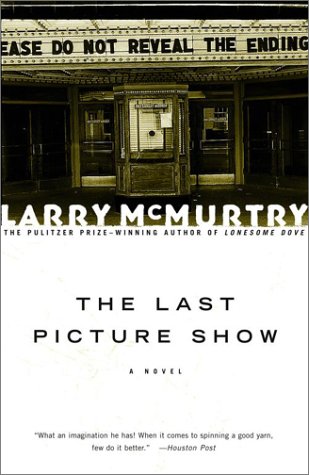
The Last Picture Show & Lonesome Dove by Larry McMurtry
I have a new favorite author and he is Larry McMurtry. I loved the movie of The Last Picture Show, and I can not begin to tell you how blown away I was by the book. Simply unbelievable. Simultaneously so sad, angsty, moody and full of life. Every character so fully realized. An incredible portrait of a place and a group of people aching for something more out of life. One of the greatest coming of age novels ever. And there's a lot of mid-life crisis happening as well. So it's a great read for the whole family. Interestingly, I watched the movie again after reading the book, and you know what, the book blows it out of the water. The movie is faithful, perhaps to a fault. It's just like the book, but with sections cut out. Read this book.

I was so energized, I decided to tackle the epic Lonesome Dove. A couple of Texas Rangers no longer needed as the West has already been settled. They head off on one last adventure--a brutal cattle drive from Texas to Montana. It's so cliched at it's core, yet unbelievable as it plays out. Captain Call and Augustus Mcrae are two fantastic characters. So different, yet totally co-dependent. 900+ pages, but page turners, all of them. Death comes quickly on the plains, so be prepared. Can't wait to watch the 6 hour mini-series.

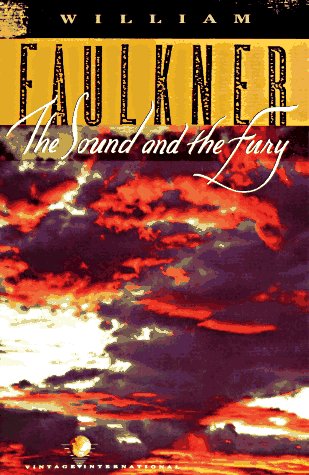
The Sound & The Fury by William Faulkner
After Lonesome Dove, I wanted something classic and satisfying. A good piece of writing with epic scope and grandeur. I decided to revisit Faulkner whom I hadn't read since high school--with mixed feelings, I might add. Here's my facebook status update that was inspired by my feeble attempt at reading this classic. "Could someone explain The Sound and the Fury to me. Why do people like that thing? It's insufferable and seems needlessly confusing. Am I wrong? When it does make sense, I find the characters irritating. I bailed after 100 pages. Is that so wrong? Help me, people. I wanted to sink my teeth into a classic, but yukkie poo poo." Well there you have it. A modern American classic dismissed so callously on Facebook. I've sunk to new lows.

Wednesday, May 5, 2010

The Magic of Radio: RIP Ernie Harwell

I never really listen to the radio anymore. As a kid I listened to it all the time. The AM oldies stations, the FM top 40 stations, the Canadian stations floating in from north of the boarder and, of course, Tigers’ baseball on WJR. If you were a sports fan in the 70s, you listened to the radio. Sports didn’t dominate tv like it does today. Maybe there were 1 or 2 games on tv a week, but if you were a fan, you got the skinny from the radio. And was there ever a better radio broadcaster than the great Ernie Harwell? I doubt it. Harwell passed away yesterday after a year-long battle with cancer.

Harwell’s southern tinged drawl was part of the fabric of childhood. Graceful and engaging, Harwell brought life to one of the most moribund teams in the 70s. The Tigers were perennial losers, but Harwell breathed life into guys like Tom Veryzer, Gary Sutherland, Ron Leflore, and Joe Coleman. And he made great calls. When watching a game today, if someone takes a called 3rd strike, I still hear Harwell’s classic call, “He stood there like a house by the side of the road and watched that one go by.” Whenever a fan would catch a foul ball, Harwell would offer up, “A young man from Muskegon takes home a souvenir.” Every foul ball featured a fan from a different city. As a 10 year old, I couldn’t wait for someone from Southfield (my town) to catch one. I was fascinated and wondered how Harwell could know where everyone was from. The 12 year old in me knew that he couldn’t know where everyone was from and that he had to be making it up. But to this day there’s that sliver of doubt. Maybe he did know. He had that magical voice coming out of the radio. He was at every Tiger game, the place you wanted to be as a kid. He was such a commanding and compassionate presence, someone who all fans were connected to, that perhaps he could know something so unknowable.

I never listen to the radio anymore. But were there any better childhood moments than being tucked into bed, listening to the West Coast games on my clock radio? Ten-thirty pm start times. Hiding under the covers. Trying to stay awake as long as possible. The crackle of the AM lulling you to sleep sometime in the 3rd or 4th inning.

When Jonathan Richman sings “With the radio on!” in Roadrunner, I think of the AM, I think of the lazy Midwest summertime, I think of listening to Tiger baseball on the radio. I hear the hum of the radio as the signal fades and then gets stronger.

RIP Ernie Harwell.

Tuesday, March 9, 2010

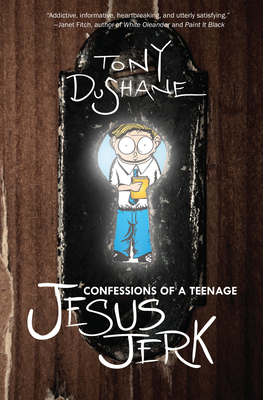
Confessions Of A Teenage Jesus Jerk by Tony Dushane

Just finished my friend Tony Dushane’s Confessions Of A Teenage Jesus Jerk. What a great read. Funny, heartfelt, and pre-pubescently painful. The book immerses you into the teen years of a horny Jehovah Witness. If you think being a teen is tough, try being a teen as a Witness where every prurient thought, let alone action, is considered a sin. Armageddon is on the horizon and masturbating can get you disfellowed. Mine fields all around. The first half of the book is a real eye opener to the ways of the Jehovah’s, which I knew next to nothing about prior to this read. The second half gets painful as Gabe, DuShane’s main character, loses contact with his lifelong friends and begins to discover the world around him. Poetry and punk rock become Gabe’s salvation, but the need to return to the fold is strong. The tension between lusting after worldly desires, yet being true to your religious upbringing is at the heart of this book. The resultant inner-turmoil feels real, honest, and raw. If you’re a sucker for coming of age stories, check it out.

Dushane reads at Phoenix Books in SF on Thursday April 15, 6-8 pm, 3957 24th St., SF, CA 94114

Friday, February 26, 2010

RIP Andrew Koenig

For the past week I’ve been following the story of the disappearance of Andrew J. Koenig. The story came to a tragic end, Koenig being found dead in Vancouver yesterday. His father, Walter Koenig (Chekov of Star Trek fame), reported that his son’s death was a suicide. Most people knew Andrew for his role as Boner on Growing Pains. I never watched that show and couldn’t pick Andrew out of line up based on that role. But for the past several years I’ve been an avid listener of the Never Not Funny Podcast, a great comedy podcast for which Andrew tweaked the knobs. Andrew often appeared on mic, sharing stories about his life. Given that his sister Danielle often appears on the show, and the show is hosted by his brother-in-law, Jimmy Pardo, I feel like I know a lot about the Koenig family.

Interestingly, Andrew also serves as the inspiration of one of my all-time favorite short stories, Jeffty Is Five by Harlan Ellison. Jeffty is a beautiful and tragic story about the loss of innocence and childish wonderment. Ellison is a great writer and for most of his short stories he writes evocative forwards talking about the given story’s inspiration. Jeffty is largely inspired by a brief chat Ellison had with the five year old Andrew at a party thrown by his parents. I’ve posted that intro here. In the light of this week’s events, Ellison’s words serve as a touching tribute to Andrew. Please note that Ellison refers to the child as Josh, which is Andrew’s given name. Also, if I've misinterpreted any of this, my apologies.


Friday, February 12, 2010

The Girl Who Played With Fire by Stieg Larsson

189 pages of boredom followed by 314 pages of page-turning excitement. What’s up with that? Stieg Larsson appears to be quite the international writing sensation for his Millenium trilogy of crime books. At some level, I don’t entirely get it. On the one hand, I love certain aspects of his books, but on the other hand, some aspects of his books leave me cold. Punk rock, lesbian, Satanist, computer hacker Lisbeth Salander and publishing bad-boy Mikael Blomqvist are back in The Girl Who Played With Fire. This time they’re trying to get to the bottom of an international prostitution ring. But I swear, almost nothing of interest happens for 189 pages. I’ll give Larsson the benefit of the doubt and suggest that over the first third of the book he has effectively laid down the groundwork for the final acts, because on page 190 things turn on a dime and get damned exciting. I really hard a hard time putting the book down. Conversely, I had a pretty hard time picking it up until that point. I imagine I’ll read the third installment, but I’ll definitely be hoping that he has finally written a book that is scintillating throughout.

Here's what I had to say about the first installment.